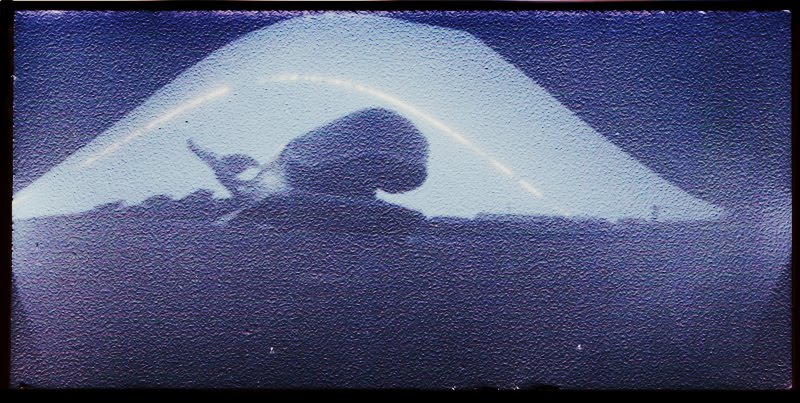
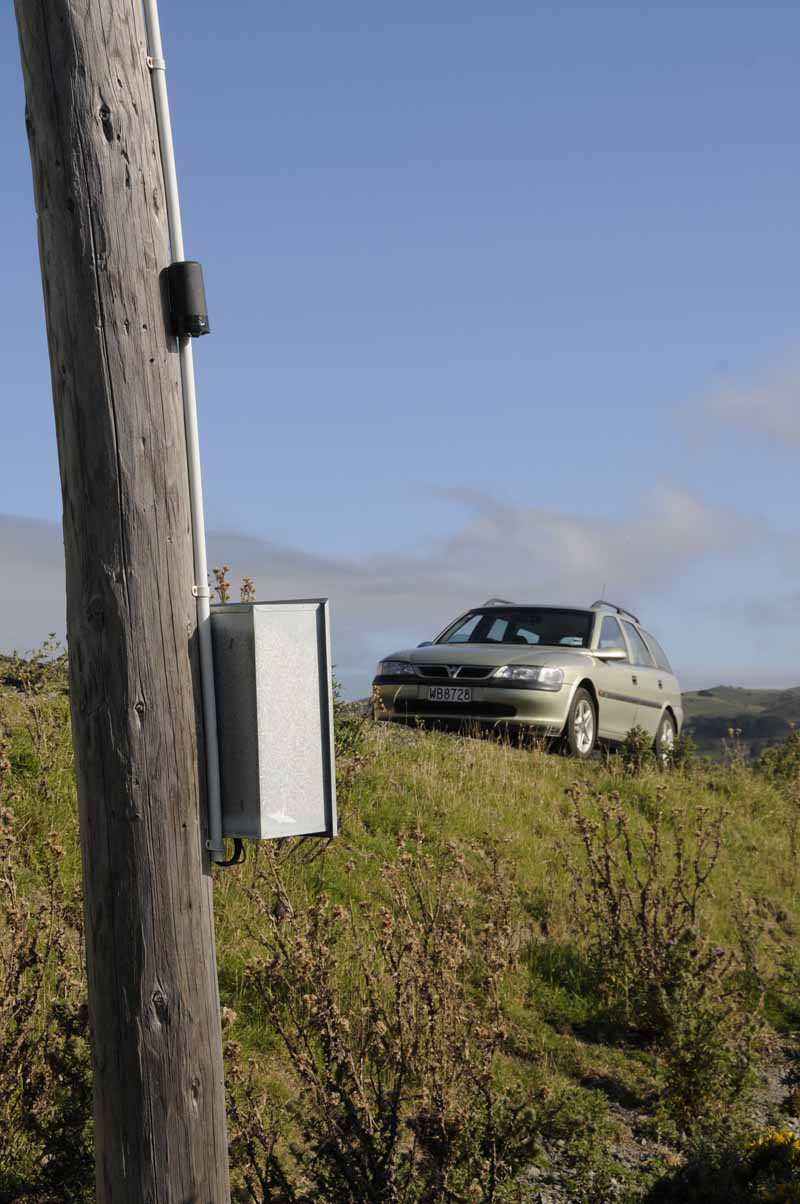
Aramoana from Taiaroa

Robbie

Priory II

Priory I

The Temple Gallery, 29 Moray Place


When I first read about solargraphy I knew that I would become an enthusiast. It is in many ways the antithesis to digital photography in that the equipment is scrounged or made cheaply, the time periods involved are astoundingly long in comparison and the in-camera results are completely unique and unreproducible. All this suited me for one reason or another but I was also attracted to working without a digital camera. I often have a feeling of a kind of nakedness if I’m out without my camera, worried that I will miss an unexpected opportunity for a great image. I don’t get that feeling if I have my camera bag full of charged pinhole cameras with me. If I can realise the beauty of the world one way or another, then I am relaxed.
Perhaps the strangest attraction of this method of image making relates back to Matt’s bomb scare. Of course people are going to be suspicious of small objects in unusual places, perhaps even more so if it is realised that these are cameras. We live in an age where surveillance by the authorities is becoming more prevalent while at the same time police and security guards overstep their powers in preventing public photography in public places. That might be overstating the case in this country but it is a growing trend particularly in the United Kingdom and the United States as evidenced by the organised backlash to this by groups such as The Love Police. All the same, when I fix a pinhole camera in a public place I am aware that it might appear as a suspicious activity. The camera itself will not last long if it is in a position where it is easily noticed. The game that I play while setting out cameras is to try to out think the person who might spot it. I have learned to avoid placing them at eye height or on a plain surface where they will stand out. I often see a likely position for placement but must return there at a time of day when less people are around to see me place it. I will prepare the double-sided tape used to attach the camera and remove the tape covering the aperture slightly beforehand so that I can walk up to my chosen spot, attach the camera and walk away with barely a pause. It is the thrill of spycraft as taught by Le Carré, the exhilaration of trying not to be caught in the act. It’s a kind of guerrilla photography. Now that the subject has been made national news and the police have stated that they want to be informed about such art projects the game’s stakes have been increased.
Solargraphy is an extension in both of those creative directions at once. It allows us an unblinking gaze at the view for a moment that lasts for months. It distorts the world to show a place like it never was and yet always is. We are reminded, if we think about it, how narrow the field of our perceptions are. And if we don’t think about it we are still presented with pretty pictures to gaze upon momentarily.


Screen grab: Chanel 9 Online
Something occurred part way through the development cycle. Fellow art student Matt Wilson began a solargraphy project of his own. He employed a similar technique to the one I did but was not as interested in discretion as I was. The outcome was that a cluster of his cameras attached to a bridge were noticed and mistaken to be an Improvised Explosive Device. Although in this part of the world it may seem like an overreaction by the police to some unusually located Coke cans, it should be noted that a genuine malicious bomb scare had closed Dunedin International Airport the day before. The events that followed included the evacuation of eleven houses, the closing of the main highway south of Dunedin and the Bomb Squad flying from Christchurch by helicopter for the second time in as many days. To his credit Matt volunteered himself to the police as soon as he realised that it was his pinhole cameras that had caused the commotion. Following on from that fuss was the round of apologies and embarrassment from Matt and on his behalf by the School of Art. Then came a feature article on Matt and his solargraphy in the arts section of the Otago Daily Times.

Otago Daily Times 6 May 2010
When I heard from Matt about the incident soon after it occurred I knew it was going to generate interest for him. Difficult and embarrassing for sure and for a while with the possibility of a criminal charge, but still, a pretty spectacular jump start for an artist early in his career.
My feelings at this point were mixed. I was not the originator of the technique of solargraphy but I felt that I had some claim to be associated with pioneering solargraphy in Dunedin. I had been enthusiastically working on my solargraphy project for one and a half years developing it, I had thought, as an art form. I mentioned this in conversation to Nigel Benson, the author of the ODT arts section article about Matt, several months before the Koremata St bridge ‘bomb’ scare. I was upset that there was nothing in that article to suggest that Matt had not invented the technique himself. Recognition for my work seemed to have been taken from me. I was disgruntled and didn’t want to be.
I realise now that the presumed challenge to my ‘ownership’ of solargraphy in the local setting forced me to re-examine my work. What had I achieved after making and setting out dozens and dozens of cameras? What discoveries had I made over all that time of development? What had I brought to solargraphy that was genuinely creative? I determined that I needed to see it only as a technique and not an art form in itself. The bright streaks of light across the sky should not be the focus of the viewers attention, rather it was how I used the technique to convey a feeling or a narrative that should be my focus. I re-examined how I selected the images that lead the direction of my project. I reconsidered earlier images that were somehow interesting but had not shown the ‘required’ amount of solar activity.
Paul Virilio wrote about the pioneering photography of Nicéphore Niépce: “The main aim of the heliographic plate is not to revel the assembled bodies so much as to let itself be ‘impressed’, to capture signals transmitted by the alternation of light and shade, day and night, good weather and bad, the ‘feeble autumn luminosity’ that hampers Niépce in his work” .
I thought of my work along similar lines. The object was not to record an image of what could be seen, rather the light and conditions should be allowed to act upon the paper. The resulting image is made from the actions of the things that we expect and know about such as the position of viewable objects and movement of the sun. There other things at work here that we are not aware of. What objects pass before the camera too briefly to be recognisably recorded? Anything that happens within the field of view during daylight will reflect light from it’s surface and through the pinhole. Whether a trace is left on the paper may be impossible to say. At a certain level of detail there is too much noise and uncertainty to tell. Solargraphs often seem to contain mysterious marks and figures that perplex even an experienced solargrapher. My renewed focus brought me to reconsider those images with mysteries. I did not now see them as imperfect landscapes or architectural studies. Instead I began to read them at face value. Previously I might have thought, ‘What is that blue dot on a field of red?’, now I think ’Why am I moved by that blue dot?’
Other aesthetic choices evolved along the way. I became more interested in the play of sunlight upon water and through trees. The effect of these things on the images was an increase in chaotic patterns and weird colours. I sought places to fix my cameras that made more of this. Without fail the resulting paper image would be nothing like my mental image as I set the cameras yet I composed the shots as if I had complete control.


This is my intention within my current studio practise: to extend the viewer’s perception of time beyond the everyday norm through the technique of extreme long exposure photographs. However, whether I have succeeded or not in this task seems to me to have become eclipsed by the often unexpected results. The worked-on images that have eventually appeared on my monitor (to my mind somehow like they mysteriously do in the chemical tray to the Darkroom Developer) often resemble nothing like my pre-visualisation. Dark and foggy exposures, unusual distortions, inexplicable farfopteros; I am often at a loss to explain where and how an image was made.
Something else takes over as the core aesthetic of the image. They seem inhabited by an atmosphere or mood. I was asked if any of the images I made in the long disused Priory showed ghosts. ‘All of them,’ I replied. Each image is a raft of unanswered questions. There has been a continuing discussion among my friends whether the images are more successful as artworks if each is presented with an explanation of where it depicts and what it is about or whether the image itself should be able to stand alone. I cannot commit myself to an answer either way.
I once attended a workshop run by a digital photographer who showed us his method for creating his award winning atmospheric landscapes. He added layer upon subtle layer of textures onto his images. A touch of tree bark, a shimmer of lace, toned down and washed out. I felt that his work was fakery and was unimpressed by the images. With these solargraphs, however, the atmospheric effects come unbidden and without my intention to add effects. The process gives equal opportunities to serendipitous enhancement as to unfortunate spoilage and it is left to me to choose which is which.
I should mention at this point my relationship with serendipity. I believe that it can be used as a method. When working with known qualities and proven formula the result will probably be predictable, which may not be a good thing. If one stirs it up and adds some randomness, one may have to work like hell to salvage the whole mess. It is between the gaps in the creaking structure that one allows something unexpected and possibly brilliant into the creation. In my experience of theatre studies, groups would often be called. The cool and clever invariably got together and produced predictably cool and clever results. I learned to wait until there were only the unconfident and the misfits left to make the last group and I would join them. This is the group that I thought had a chance to produce something unpredictable and possibly astounding.

Axel with box of pinhole cameras
One aspect of working on a project that involves such long time frames is that it is difficult to make developments within a shorter time frame. That is the predicament I found myself in this year when I decided to use solargraphy as my subject for studio practise. In some respects it was an easy choice. I had begun work on it a year previously so was already well involved. More importantly, I was still fascinated by the process and eager to explore it further. At one point I thought I might have it a bit too easy; I was sitting back while my cameras were out in the world working while other students were busy worrying about studio time and finding models. I realised my folly when it was time for me to evaluate my work so far in order to develop it further. If I processed my images early I was missing out on months of exposure time and possibly wasting the months that had gone into them so far. It became a compromise. I brought in cameras that may not have been fully ‘cooked’ and used the results to inform the sets of shorter term cameras that I set out. I found my direction moving from an interest in pure landscape and sky images to more subject orientated ones.
At this time I was also becoming frustrated with technical issues. The new high resolution Epson V30 scanner I had bought was not performing well. The images appeared with coloured bands across them. The cause puzzled me but I now think that it happened because the buffer filled in the scanner memory causing it to pause a number of times mid scan, each pause created a band. I returned to my original scanner but was not sure what to make of the images 'damaged' by faulty scans.

East facing balcony

Water of Leith, Anzac Ave bridge
Eventually, with the encouragement of my supervisor Rachel Gillies, I began to see these 'glitched' images as being interesting in themselves and chose to include some of them in the show.